Shadow AI The Tools Your Company Can't See
Shadow AI: When Employees Solve the Problem the Company Never Approved
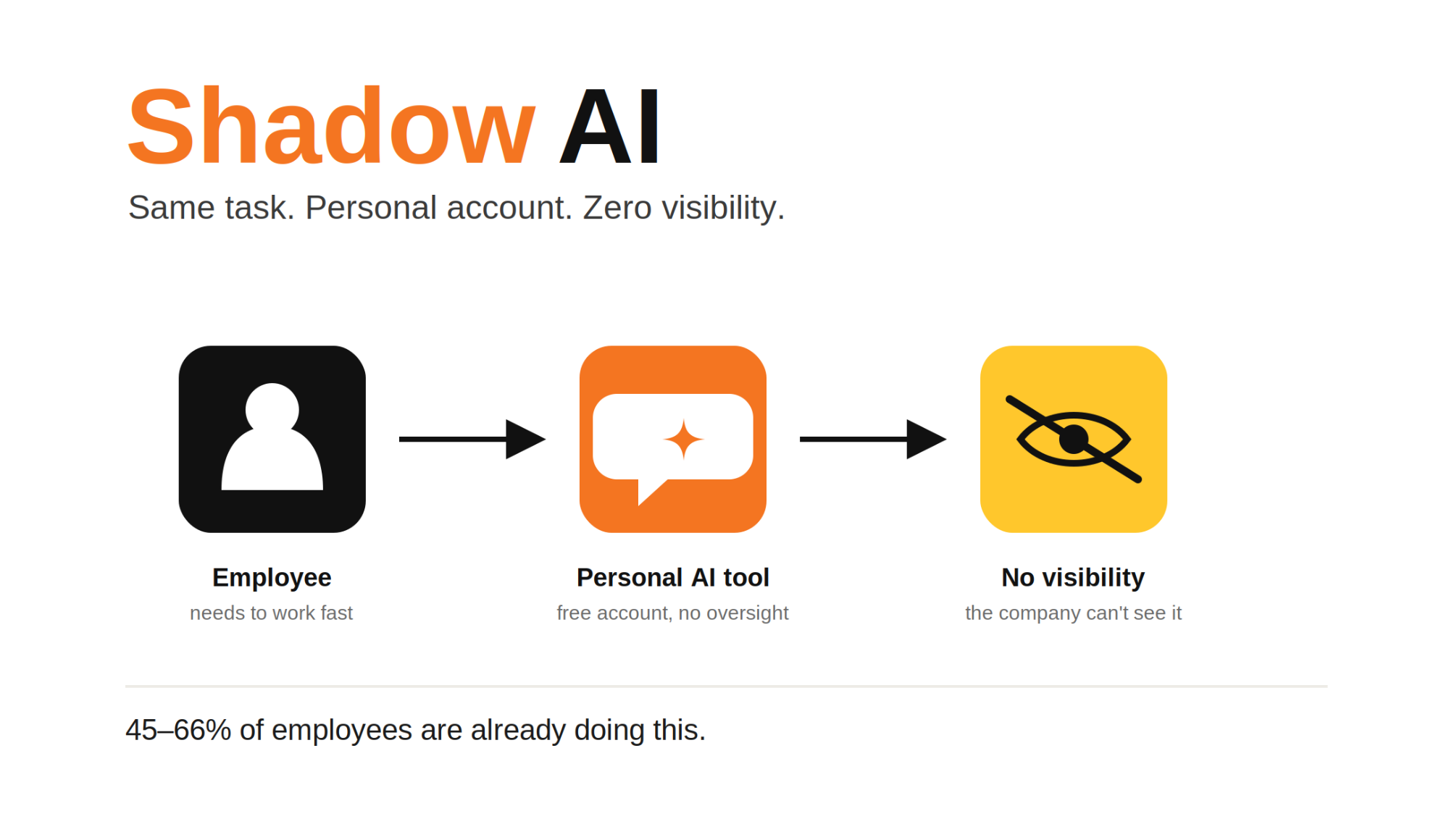
Somewhere between 45% and 66% of the workforce is now using AI tools their employer never signed off on. The fix isn't a stricter policy. It's asking why the approved one wasn't good enough.
Every AI governance policy assumes the same thing: that employees will wait for permission before they adopt a new tool.
That assumption is quietly falling apart.
Across industries, employees are not waiting for IT to approve a tool, for legal to review a vendor, or for leadership to publish a policy. They are opening a browser, signing into a free AI account with a personal email, and getting the job done. Multiple studies published this year put the share of employees using unauthorized AI tools at work somewhere between 45% and 66%, depending on the survey and the industry.
This behavior has a name now: shadow AI.
In some organizations, more AI work is happening outside the approved stack than inside it.
And that is where the real risk begins.
The Problem Is Not Employees. The Problem Is Silence.
It is tempting to frame shadow AI as a discipline problem. Someone breaks a rule, so the fix is to enforce the rule harder.
But that framing misses what is actually happening.
Employees are not usually trying to break policy. They are trying to close a gap that policy left open. A salesperson needs to draft a proposal faster than the approved tool allows. A support agent needs to summarize a ticket thread the sanctioned assistant cannot handle. A finance analyst needs to reconcile a spreadsheet and the enterprise tool is still on a six-month rollout plan.
So they use what already works. Usually a tool they discovered in their personal life, long before their employer had a position on it.
Nearly nine in ten employees who use AI at work say they first encountered the tool outside of work, according to PagerDuty's 2026 Shadow AI Survey of office professionals at large enterprises. The habit was already formed. The company simply never caught up to it.
When that gap is left open long enough, employees stop asking whether a tool is approved and start asking only whether it works.
When Trust in AI Outpaces Trust in IT
Part of what fuels shadow AI is a shift in whose judgment employees trust.
Research from UpGuard found that roughly a quarter of workers now consider their AI tools to be among their most trusted sources of information, rivaling their own manager and outranking colleagues or search engines. Employees who feel this way are, unsurprisingly, far more likely to reach for an unsanctioned tool as part of their everyday workflow.
This is a meaningful shift. It means the traditional governance model, where IT evaluates a tool and employees defer to that judgment, no longer matches how many employees actually think about AI. They believe they are the experts now. In many cases, on the specific task in front of them, they may even be right.
That confidence does not eliminate the risk. It just means the risk is not going to be solved by telling employees to trust the process more.
The Double Standard at the Top
If shadow AI were only a frontline habit, it would be easier to contain. It is not.
The same PagerDuty research found that 81% of employees believe leadership plays by a different set of AI rules than everyone else, a perception that grows even stronger at larger organizations. Separately, a BlackFog survey found that a wide majority of C-suite executives are comfortable with unsanctioned AI use across their organizations, prioritizing speed over the privacy and security concerns their own policies exist to address.
Executives, meanwhile, tend to stay quiet about their own habits. When asked, many are reluctant to disclose which tools they personally use, even as they push adoption metrics down through the organization.
A policy that leadership does not visibly follow is not a policy. It is a suggestion aimed at everyone except the people who wrote it.
This double standard matters because policy credibility flows downward. If employees believe the rules bend at the top, they will treat the rules as optional everywhere else too.
Not Every Workaround Is a Threat
It would be a mistake to treat every instance of shadow AI as malicious or reckless. Most of it starts the same way: someone found a faster way to do their job. That is not sabotage. That is often exactly the instinct organizations say they want to encourage.
- —Some shadow AI use is genuinely low risk, like polishing internal language or brainstorming.
- —Some of it exposes customer data, source code, or financial records to tools with no enterprise safeguards.
- —Some of it happens because the approved tool simply cannot do the job.
- —Some of it happens because no one ever explained what the approved tool was.
- —And some of it happens because employees do not believe getting caught carries any real consequence.
Verizon's 2026 Data Breach Investigations Report found that detections of shadow AI activity have risen fourfold in a single year, with a majority of regular AI users on corporate devices accessing tools through personal, unauthorized accounts. That volume alone should tell leaders this is not a fringe behavior. It is close to the default.
Treating all of it as a disciplinary issue misses the more useful question underneath it: what need is this workaround actually meeting, and is there a safer way to meet it?
From Policy-First to Visibility-First
Most AI governance still starts with a document: a policy that lists approved tools, prohibited use cases, and consequences for violations. Then it waits for employees to comply. The evidence suggests this sequence is backwards.
A more effective starting point is visibility, not restriction. Ask teams directly which tools they already rely on, and treat the answers as operational intelligence rather than a confession. Most leaders who run this kind of audit are surprised by how many tools surface, and by how deeply embedded some of them already are in daily work.
Visibility → Understand the gap → Provide a sanctioned alternative → Set clear data rules → Train, not just police → Monitor and adapt
This sequence works because it treats employees as a source of information about where the organization's tools are falling short, rather than as a compliance risk to be managed after the fact.
Example: The Customer Support Team
Consider a customer support function under pressure to reduce response times.
The wrong first move is to ban all AI tools until a fully vetted enterprise assistant is deployed months from now. Employees under deadline pressure will simply route around the ban, and the organization loses the one thing it needed most: visibility.
The better first move is to ask what agents are actually doing with the tools they have already found. In many cases, it is summarizing long ticket threads, drafting reply templates, or translating messages. None of that requires a sprawling AI platform. It requires a sanctioned tool that does those specific things well, with clear rules about what customer data can and cannot be entered.
Healthcare organizations that took this approach in 2026, offering an approved tool that matched the functionality employees had already found on their own, saw a significant drop in unauthorized use almost immediately. The lesson generalizes: shadow AI shrinks fastest not when it is punished, but when it is made unnecessary.
Sanctioned Doesn't Have to Mean Slower
A recurring complaint behind shadow AI is that approved tools feel slower, more limited, or more bureaucratic than the free version employees already know. If that perception is accurate, no policy will fix it. Employees will always choose the tool that helps them finish the task, regardless of what the org chart says about approval.
This means IT and security teams have a role beyond gatekeeping. They need to evaluate sanctioned tools with the same bar employees are already using: does it work, is it fast, does it actually solve the task in front of them. A secure tool that no one wants to use will not reduce risk. It will just get quietly abandoned in favor of whatever employees found first.
Shadow AI Is a Warning Signal, Not a Verdict
High shadow AI usage should not be read as evidence that employees are careless. In most cases, it is evidence that the organization's approved tools have not kept pace with what employees actually need. Nearly all organizations now have employees using unsanctioned AI in some form, according to compiled industry research, which suggests this is closer to a universal condition than an isolated failure.
Leadership questions worth asking:
- —Do employees know which tools are approved and why?
- —Is there a fast, honest path to request a new tool?
- —Do sanctioned tools actually match what employees need to get done?
- —Does leadership visibly use the same tools it asks everyone else to use?
- —Are consequences for violations consistent, or do they depend on seniority?
These questions matter more than any single enforcement action, because shadow AI is rarely about one employee. It is about a pattern that repeats until the underlying gap is closed.
The Role of Senior Leadership
Closing the shadow AI gap is not primarily an IT project. It is a leadership one. Leaders need to be visibly using the same tools and rules they expect from everyone else. They need to treat tool requests as normal operational input, not as red flags. They need to fund sanctioned alternatives fast enough that waiting for approval does not cost anyone their deadline. They need to separate genuine negligence from reasonable workarounds when deciding how to respond. And they need to ask not only how much shadow AI exists, but why employees feel they need it.
If leadership pressure is translated into a rulebook and nothing else, employees will keep finding their own way around it. If it is translated into faster, better-supported tools and honest conversations about what is and is not working, the gap that shadow AI fills starts to close on its own.
Conclusion: The Future Belongs to Organizations That Ask Why, Not Just Who
Shadow AI is not a reason to lock down every tool employees touch. It is a reason to ask a harder question: why did employees feel they had to look outside the organization to get their work done in the first place?
The organizations that close this gap will not be the ones with the strictest policy. They will be the ones whose approved tools are good enough, fast enough, and trusted enough that going around them stops making sense.
The future will not be won by the organizations that block the most tools. It will be won by the ones that make the approved path the easiest one to take.
BlackFog (2026) Shadow AI in the Enterprise Survey, as reported in Forbes and CIO, April–May 2026.
PagerDuty (2026) PagerDuty Shadow AI Survey, conducted by Wakefield Research, June 2026.
UpGuard (2025) Shadow AI and Employee Trust Report, November 2025.
Verizon (2026) Data Breach Investigations Report, May 2026.